
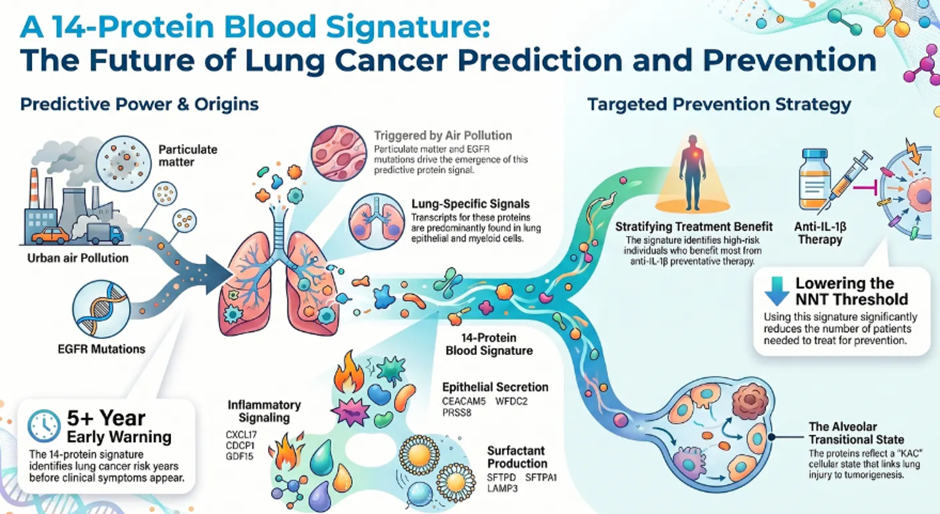
NEWS: Scientists have identified a 14-protein blood plasma signature that can predict the risk of lung cancer years before tumors become detectableà offering a major breakthrough in early cancer diagnosis.
About the Discovery
- Published in the journal Cell by a multinational team led by Charles Swanton.
- Based on analysis of data from 48,000 volunteers in the UK Biobank.
- Identified a 14-protein signature in blood plasma that serves as an early warning marker for lung cancer.
Key Concepts
- Plasma Proteomicsà Study of proteins present in blood plasma (plasma proteome) that reflect the health status of different organs.
- Liquid Biopsyà A non-invasive diagnostic method using blood samples to detect disease-related biomarkers.
- Traditional Biopsyà Involves collecting tissue directly from the organ and is invasive.
How It Works
- Blood plasma carries protein signals released by organs throughout the body.
- Diseased tissues release abnormal proteins that can be detected through advanced analysis.
- Using AI and machine learning, researchers identified a specific pattern of 14 proteins associated with future lung cancer risk.
- The signature can predict cancer years before tumors appear on scans.
Key Findings
- Chronic inflammation caused by smoking and air pollution may activate dormant mutant lung cells, leading to cancer development.
- Early detection could enable preventive interventions before cancer becomes clinically evident.
Link with CANTOS Trial
- The CANTOS Trial originally investigated whether reducing inflammation could lower heart attack risk.
- Retrospective analysis showed that participants with the 14-protein signature who received Canakinumab had about 50% lower risk of lung cancer.
- However, Canakinumab remains expensive and may cause serious side effects, prompting research into safer alternatives.
Significance
- Opens the possibility of predictive cancer screening through a simple blood test.
- Supports the shift from treatment-focused oncology to early detection and prevention.
- Demonstrates the growing role of AI, proteomics, and liquid biopsy technologies in precision medicine.