
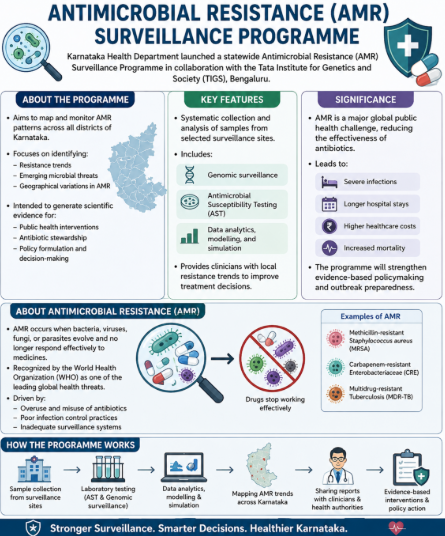
NEWS: Karnataka Health Department launched a statewide Antimicrobial Resistance (AMR) Surveillance Programme in collaboration with the Tata Institute for Genetics and Society (TIGS), Bengaluru.
About the Programme
- Aims to map and monitor AMR patterns across all districts of Karnataka.
- Focuses on identifying: Resistance trends, Emerging microbial threats, Geographical variations in AMR
- Intended to generate scientific evidence for: Public health interventions, Antibiotic stewardship, Policy formulation and decision-making
Key Features
- Systematic collection and analysis of samples from selected surveillance sites.
- Includes: Genomic surveillance, Antimicrobial Susceptibility Testing (AST), Data analytics, modelling, and simulation
- Provides clinicians with local resistance trends to improve treatment decisions.
Significance
- AMR is a major global public health challenge, reducing the effectiveness of antibiotics.
- Leads to: Severe infections, Longer hospital stays, Higher healthcare costs, Increased mortality
- The programme will strengthen evidence-based policymaking and outbreak preparedness.
About Antimicrobial Resistance (AMR)
- AMR occurs when bacteria, viruses, fungi, or parasites evolve and no longer respond effectively to medicines.
- Recognized by the World Health Organization (WHO) as one of the leading global health threats.
- Driven by: Overuse and misuse of antibiotics, Poor infection control practices, Inadequate surveillance systems