
NEWS: Chandrayaan-2 Finds ‘Possible Presence’ of Ice in Lunar South Pole
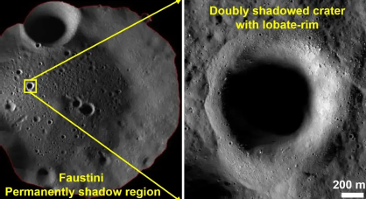
What is the Discovery?
- Scientistsà detected radar signatures indicating the possible existence of water ice beneath the lunar surface in certain areas of the Moon's South Pole.
- Focused on doubly shadowed craters located in the Permanently Shadowed Regions (PSRs) of the Moon.
- Advanced radar analysis revealed signals that are consistent with the presence of subsurface ice deposits beneath the floors of four such craters.
Permanently Shadowed Regions (PSRs)
- Permanently Shadowed Regions (PSRs)à Areas near the Moon's poles that never receive direct sunlight.
- These regions remain in darkness because of the Moon's small axial tilt.
- Since sunlight does not reach these regions, temperatures remain extremely low.
Role of DFSAR
- The discovery was made using the Dual Frequency Synthetic Aperture Radar (DFSAR) onboard the Chandrayaan-2 Orbiter.
- DFSAR sends radar signals toward the lunar surface and studies the reflected signals.
- Different materials reflect radar waves differently.
- By analyzing the reflected radar signatures, scientists can identify substances hidden beneath the surface.
Radar Polarimetric Analysis
- Scientists used advanced Radar Polarimetric Analysis techniques.
- This method studies the polarization characteristics of reflected radar waves.
- The observed radar patterns matched signatures expected from subsurface water ice deposits.
- However, scientists have used the phrase "possible presence" because direct physical confirmation is still required.
About Chandrayaan-2
- Chandrayaan-2 was launched by ISRO on 22 July 2019.
- It was India's second lunar exploration mission after Chandrayaan-1.
- The mission consisted of: Orbiter, Vikram Lander, Pragyan Rover