
NEWS: Researchers have developed a new method to recover gold from electronic waste (e-waste) using modified rice paper.
CONTEXT
- Uses a chemically treated starch-based rice paper that can selectively extract gold from complex electronic waste solutions.
- Considered cost effective, environmentally friendly, and useful for recycling valuable metals from discarded electronic devices.
Background
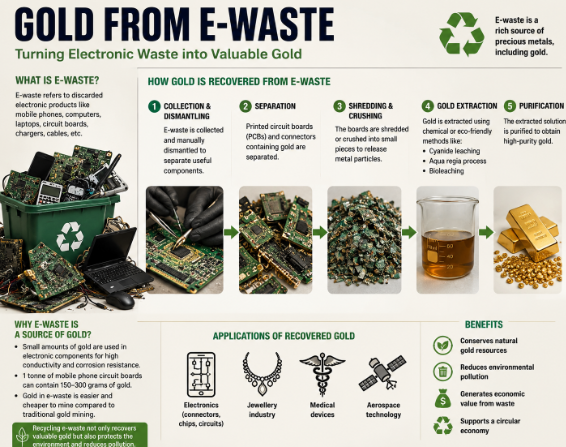
- Electronic waste (E-waste)à Discarded electronic devices such as computers, mobile phones, televisions, circuit boards, and other electronic equipment.
- E-waste contains valuable metals such as gold, silver, copper, palladium, and platinum.
- Recovering these metals reduces the need for mining and helps conserve natural resources.
- Traditional metal recovery methods often involve hazardous chemicals and generate pollution
Rice Paper
- Rice paper is a thin edible material commonly used in food preparation.
- It is primarily made from starch-based compounds.
- Researchers modified this paper to make it capable of selectively capturing gold from waste solutions.
How Does the Technology Work?
- Electronic wasteà First dissolved into a liquid solution containing various metal ions.
- The modified rice paper is then placed into this solution.
- The paper selectively attracts gold ions while ignoring many other metals.
- Once attached to the paper, the gold ions are chemically reduced into solid gold nanoparticles.
- These nanoparticles accumulate on the surface of the paper.
- The paper can later be burned, leaving behind pure metallic gold for collection
SIGNIFICANCE
- Provides a sustainable method for recovering valuable metals from ewaste.
- Reduces environmental pollution associated with conventional extraction methods.
- It promotes the circular economy by recovering and reusing precious resources.
- Can reduce dependence on mining activities.
- Helps address the growing challenge of e-waste management.
India and E-Waste
- India is among the world's largest generators of electronic waste.
- The government regulates e-waste management through the E-Waste (Management) Rules, 2022.
- These rules are based on the principle of Extended Producer Responsibility (EPR).
- Under EPR, manufacturers are responsible for collecting and recycling end-of-life electronic products.