
NEWS: A recent study showed that ground-based space particle detectors can track Earth's weather and solar storms in real timeà highlighting the importance of the GRAPES-3 Muon Telescope.
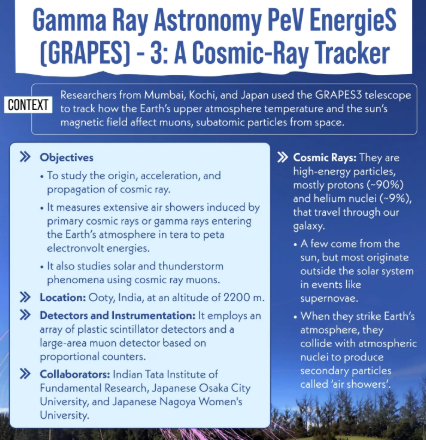
ABOUT
- GRAPES-3 (Gamma Ray Astronomy at PeV EnergieS)à High-altitude cosmic-ray observatory.
- Operated by the Tata Institute of Fundamental Research (TIFR).
- Located in Ooty.
- Commissioned in 2000.
- Developed through collaboration between India and Japan.
- Houses the world's largest tracking muon telescope.
KEY FEATURES
- Studies cosmic muons produced when cosmic rays interact with Earth's atmosphere.
- Detects billions of muons daily.
- Serves as a ground-based tool for monitoring:
- Upper atmospheric changes
- Solar magnetic activity
- Space weather events
IMPORTANT OBSERVATIONS
Atmosphere–Muon Link
- Higher atmospheric temperatures cause the atmosphere to expand.
- Fewer low-energy muons reach the Earth's surface.
- Lower muon count indicates a warmer upper atmosphere.
Solar Magnetic Field–Muon Link
- Stronger solar magnetic fields block more cosmic rays.
- Fewer cosmic rays produce fewer muons.
- Muon count decreases when solar magnetic activity increases.
Data Analysis
- Uses Fast Fourier Transform (FFT) and other mathematical techniques.
- Filters seasonal and solar-cycle effects to obtain accurate observations.
SIGNIFICANCE
- Provides real-time monitoring of space weather and climate-related atmospheric changes.
- Enhances understanding of Sun–Earth interactions.
- Supports research in cosmic rays, atmospheric science, and solar physics.
Demonstrates how particle physics can contribute to climate and weather studies