
NEWS: India requires adequate climate financing for energy transition, emissions reduction, climate adaptation and sustainable development.
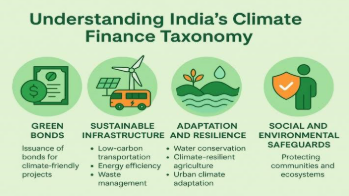
Government Initiatives
- Sovereign Green Bonds (SGBs)à Issuance of ₹477 billion SGBs to finance green projects.
- National Adaptation Fund for Climate Change (NAFCC)à To support adaptation activities in the States and Union Territories (UTs) vulnerable to the adverse effects of climate change.
- National Clean Energy and Environment Fund (NCEEF)à Finances and promotes clean energy, renewable energy technologies and related research and innovation in India.
- Priority Sector Lending (PSL) frameworkà Includes Green activities and sovereign green bonds.
- Climate Finance Taxonomy and Green Steel Taxonomy; RBI's Climate Finance and Climate Risk Management Directions (2025) etc.
Challenges
- Massive financing gap and inadequate international climate finance commitments.
- Lack of a comprehensive climate finance architecture and clear green classification.
- Limited private-sector participation due to high risks and low profitability of green technologies.
- Inadequate integration of climate risks into financial decision-making.
- Other challenges: Risk of greenwashing; limited borrowing capacity and access to states; etc.
Major Global Climate Finance Mechanisms
- Global Environment Facility (GEF)à Supports climate, biodiversity, and environmental projects
- Green Climate Fund (GCF)à Funds climate mitigation and adaptation projects.
- New Collective Quantified Goal (NCQG)à Commits $300 billion by 2035.
- Others: Adaptation Fund (AF); Least Developed Countries Fund (LDCF); Special Climate Change Fund (SCCF) etc.