
NEWS: NCERT à Announced that it will replace a retouched image of the iconic Mohenjo-daro Dancing Girl in its new Class 9 Art textbook.
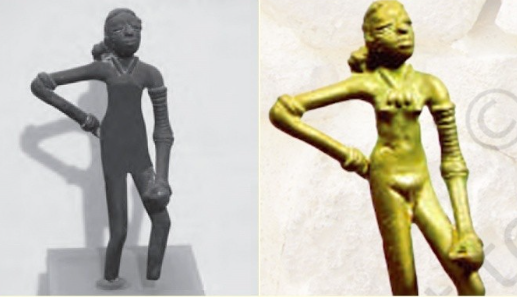
About The ‘Dancing Girl’ of Mohenjo-daro:
- Masterpiece of prehistoric art and a free-standing, realistic bronze statuette depicting a slender young woman.
- Standing at approximately 4 inches (10.5 * 5 * 2.5 cm) in height
- Defining symbols of the Indus Valley Civilisation (Harappan Civilisation).
History
- Unearthed in 1926 by British archaeologist John Marshall àDuring excavations at Mohenjo-daro (located in present-day Sindh, Pakistan).
- Marshall coined the term Dancing Girl because her asymmetrical stance reminded him of the posture of contemporary nautch girls (female dancers in traditional Indian courts).
- The statue is dated back to the peak of the Bronze Age, around 2500 B.C.E. (or a broader period of 2700–2100 B.C.E.).
Key Physical Characteristics
- The figure stands with her feet apart and her body weight distributed unevenly, resting slightly on her right leg.
- Her right arm is bent at the elbow with a clenched fist propped against the back of her hip, while her elongated left arm hangs loosely by her side, holding what appears to be a small vessel.
- She also wears a simple cowry-shell necklace.
- Her hair is neatly coiled into a tight bun resting at the nape of her neck.
- Her face features exaggerated proportions—including a high forehead, large eyes, a wide nose, and full lips—and is tilted upward with a confident and defiant demeanor.
Significance
- Demonstrates Harappan expertise in the complex lost-wax casting technique and advanced bronze metallurgy.
- Its copper-tin alloy composition shows deliberate knowledge of durability and metal engineering.
- Figure may represent a warrior, youth, or ethnic identity rather than simply a dancer. These interpretations reflect the unresolved social meanings of Harappan art.
- Unlike most Harappan human figures made of terracotta, this sculpture is crafted in bronze using a sophisticated process