
ENVIRONMENTAL GOVERNANCE
ENVIRONMENTAL GOVERNANCE in India suffers more from fragmented knowledge than the absence of data. In this context, examine the need for an Annual Environmental Survey of India (EnvSI).
Model Answer
Introduction
- India faces growing environmental challenges including climate change, pollution, biodiversity loss, and land degradation.
- Despite large amounts of environmental data being collected, the absence of an integrated assessment framework limits effective policymaking.
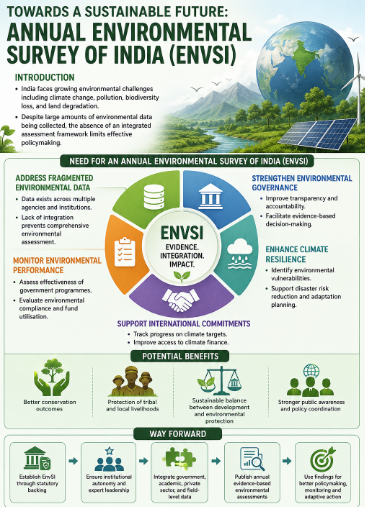
Need for an Annual Environmental Survey of India (EnvSI)
Address Fragmented Environmental Data
- Data exists across multiple agencies and institutions.
- Lack of integration prevents comprehensive environmental assessment.
Strengthen Environmental Governance
- Improve transparency and accountability.
- Facilitate evidence-based decision-making.
Enhance Climate Resilience
- Identify environmental vulnerabilities.
- Support disaster risk reduction and adaptation planning.
Monitor Environmental Performance
- Assess effectiveness of government programmes.
- Evaluate environmental compliance and fund utilisation.
Support International Commitments
- Track progress on climate targets.
- Improve access to climate finance.
Potential Benefits
- Better conservation outcomes.
- Protection of tribal and local livelihoods.
- Sustainable balance between development and environmental protection.
- Stronger public awareness and policy coordination.
Way Forward
- Establish EnvSI through statutory backing.
- Ensure institutional autonomy and expert leadership.
- Integrate government, academic, private sector, and field-level data.
- Publish annual evidence-based environmental assessments.
Conclusion
An independent and comprehensive EnvSI can transform environmental governance by making ecological realities visible, improving accountability, and helping India pursue sustainable development while meeting its climate obligations.