
Illicit Liquor Among the Poor
Weak Enforcement and Poor Regulation Sustain Illicit Liquor Among the Poor
Model Answer
Introduction
- India has witnessed several mass deaths due to consumption of illicit liquor in States such as Tamil Nadu, Gujarat, Punjab, Uttar Pradesh, Bihar, Assam, Maharashtra and others.
- Despite repeated promises of reform after each tragedy, systemic changes have remained inadequate.
- Recently, the Pune-Pimpri Chinchwad illicit liquor tragedy once again exposed the weaknesses in regulation and enforcement
Illicit Liquor (Hooch)
- Illicit liquor refers to alcohol produced, sold or distributed outside the legal regulatory framework.
- It is usually cheaper than licensed alcohol and is often consumed by economically weaker sections.
- Dangerous because producers frequently mix toxic chemicals to increase profits.
Role of Methanol in Hooch Tragedies
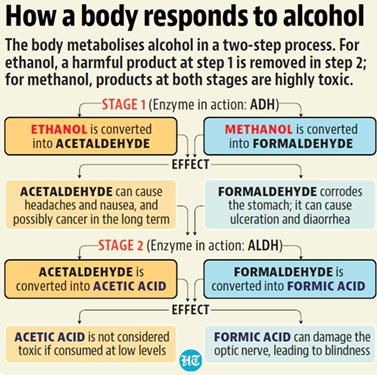
- Methanol (methyl alcohol) is an industrial chemical used in products such as solvents, paints and fuels.
- Methanol is highly toxic for human consumption.
- Even small quantities can cause: Blindness, Organ failure, Death.
Demand for Illicit Liquor Exist
High Price of Legal Alcohol
- State governments impose high taxes on alcohol.
- This increases the retail price of licensed liquor.
- Poor consumers often shift towards cheaper illicit alternatives.
Economic Hardships
- Most victims belong to working-class or daily wage labour backgrounds.
- Economic constraints make legal alcohol unaffordable for many consumers.
Addiction and Social Factors
- Continuous physical labour and difficult living conditions create demand for cheap intoxicants.
- Addiction often overrides concerns about quality and safety.
Why Do Hooch Tragedies Continue Repeatedly?
Weak Regulation of Methanol
- One major problem is the poor tracking of industrial methanol.
- Methanol can be easily diverted or stolen from legitimate industrial uses.
- Regulatory systems fail to effectively monitor its movement and final use.
Weak Enforcement
- Illegal liquor networks often operate openly within local communities.
- They survive because of inadequate monitoring and enforcement.
- Allegations of collusion between illicit traders and local authorities frequently emerge.
Poor Conviction Rates
- Legal reviews show that even when arrests are made, convictions are often rare.
- Weak prosecution reduces deterrence and allows illegal activities to continue.
Impact of Alcohol Prohibition
- States such as Bihar and Gujarat have implemented prohibition policies.
- While the objective is to reduce alcohol consumption, complete bans often create black markets.
Public Health Dimension
- Public health experts have estimated that around 40% of alcohol consumption in India may come from the illicit market.
- This creates a significant health burden due to poisoning, addiction and preventable deaths.
Solutions Suggested by the Article
Improve Methanol Monitoring
- Establish a strong tracking mechanism for production, transportation and usage of industrial methanol.
- Prevent diversion into illegal alcohol production.
Strengthen Enforcement
- Focus investigations on the entire supply chain rather than only retail vendors.
- Identify financiers, suppliers and criminal networks.
Improve Conviction Rates
- Strengthen investigation quality and prosecution.
- Ensure timely punishment of offenders.
Address Socio-Economic Causes
- Recognize addiction and poverty as major drivers.
- Provide awareness, de-addiction and rehabilitation support.
Review Alcohol Pricing Policies
- Excessively high prices of legal alcohol may unintentionally encourage illicit markets.
- Policies should balance public health concerns with market realities.
Enhance Accountability
- Investigate allegations of official negligence or complicity.
- Ensure accountability of local enforcement agencies.
Conclusion
- Repeated hooch tragedies in India are not isolated incidents but the result of regulatory failures, weak enforcement, economic vulnerability and poor accountability.
- Unless methanol diversion is controlled, criminal networks are dismantled and socioeconomic drivers are addressed, illicit liquor will continue to pose a serious public health and governance challenge.
- Sustainable reforms require a combination of regulation, enforcement, public health interventions and political commitment.