
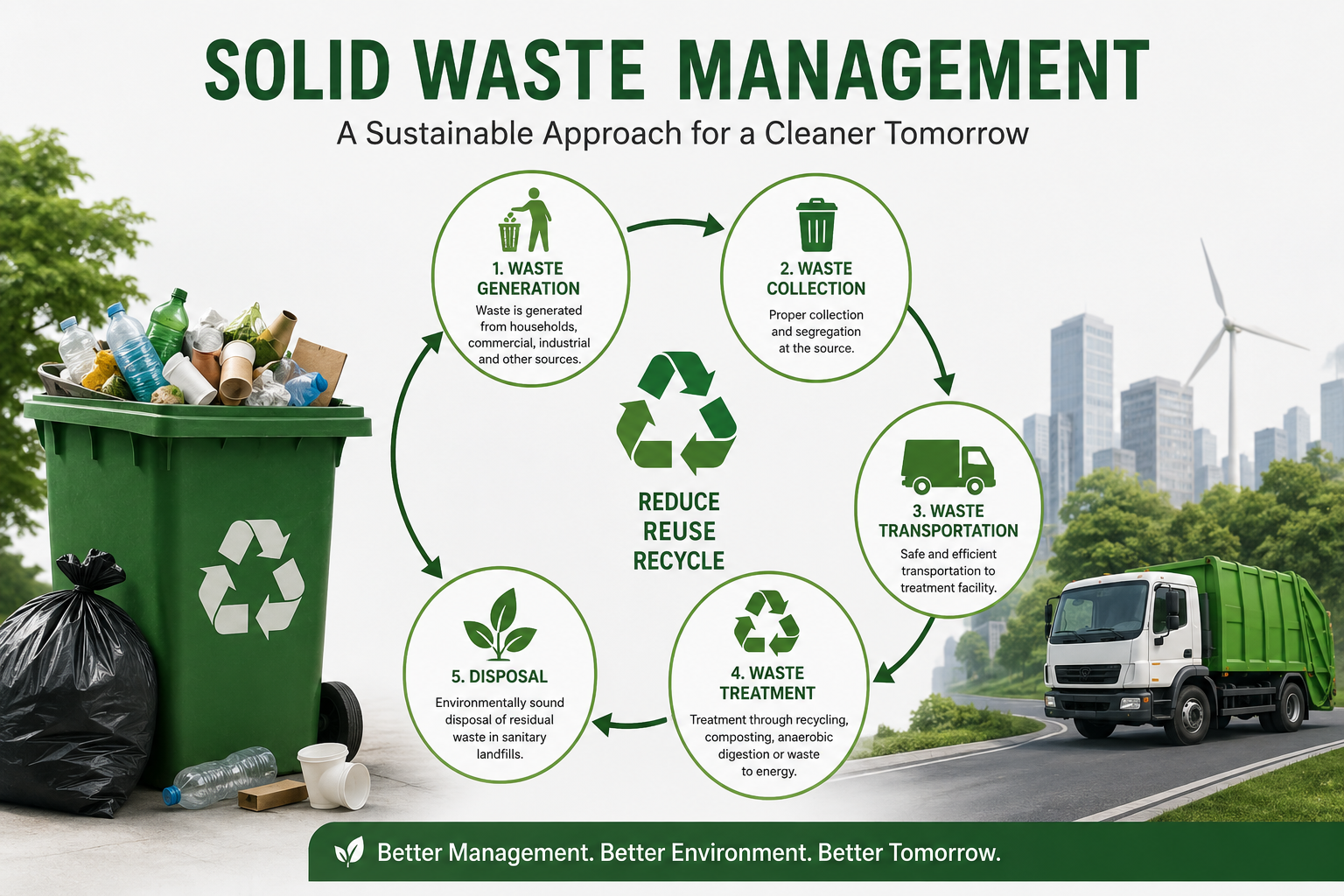
The Ministry of Environment, Forest and Climate Change has notified the Solid Waste Management (SWM) Rules, 2026, which will come into effect from 1 April 2026.
NEWS: The Ministry of Environment, Forest and Climate Change has notified the Solid Waste Management (SWM) Rules, 2026, which will come into effect from 1 April 2026.
ABOUT
- Solid Waste Management (SWM) Rules, 2026 are notified under the Environment (Protection) Act, 1986.
- They provide a comprehensive regulatory framework for solid waste management in India.
- The Rules integrate Circular Economy principles to promote waste reduction, reuse, and recycling.
- They incorporate Extended Producer Responsibility (EPR), making producers accountable for post-consumer waste.
- The new rules shift focus toward on-site processing, digital tracking, and economic penalties to ensure compliance.
KEY HIGHLIGHTS
- Waste generators must now segregate waste into four distinct categories: Wet Waste, dry waste, sanitary Waste, special Care Waste
- Entities with a floor area of 20,000 sqm+ or generating 100kg+ waste daily are now Bulk Waste Generators.
- Extended Bulk Waste Generator Responsibility (EBWGR):BWGs account for 30% of total waste, making their role critical for decentralization.
- CPCB will levy environmental compensation for: Operating without registration, False reporting or forged documents., Improper waste disposal practices.
- RDF (Refuse Derived Fuel) is produced by shredding and dehydrating municipal solid waste with high calorific value, primarily consisting of non-recyclable plastic, paper and textiles
- The rules provide for the levy of EC (Environmental Compensation) based on the ‘Polluter Pays’ principle for non-compliance.
Significance
- Higher landfill fees on unsegregated waste encourage local bodies to process waste rather than dispose it in landfills.
- Mandates time-bound bio-mining and bioremediation of existing dumpsites, with quarterly progress monitoring to ensure accountability