
Published on: June 4, 2025
GM CROPS
GM CROPS
CONTEXT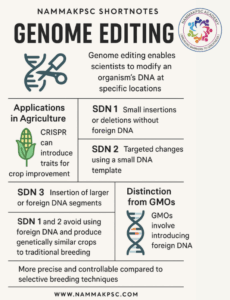
- On May 4, 2025, the Centre released two gene-edited rice varieties:
- DRR Dhan 100 (Kamala) – developed by Indian Institute of Rice Research, Hyderabad.
- Pusa Rice DST1 – developed by Indian Agricultural Research Institute, New Delhi.
- Concerns were raised by Coalition for GM-Free India regarding biosafety and export risks.
- ICAR’s Directorate of Knowledge Management in Agriculture (DKMA) responded, dismissing the fears.
CONCEPT: GENE-EDITED CROPS AND BIOSAFETY
- Gene Editing (SDN-1 & SDN-2):
- Involves precise edits to plant genomes.
- No foreign DNA inserted.
- Exempted from strict GM regulations in many countries.
- Mutation Breeding vs. Gene Editing:
- Mutation breeding uses radiation/chemicals—more random, less predictable.
- Gene editing is more targeted, with lower biosafety risks.
- ICAR’s Stand:
- SDN-1 and SDN-2 edits are mutant variants of native genes.
- Safe with >75 years history of consumption.
- India follows SOPs and global biosafety protocols.
CURRENT
- No evidence of biosafety concerns in gene-edited rice.
- Public fear termed baseless; points to successful adoption of Bt cotton (>90% farmers).
- 30+ countries exempt SDN-1 & SDN-2 from strict GMO norms.
- EU’s 2022 analysis: Gene editing has lower risk than conventional mutation techniques.
- Export concern: Released rice types are non-Basmati (EU imports minimal).
- India ready to lose minor EU market to prioritize farmer and consumer interests.

You must be logged in to post a comment.