
Published on: June 23, 2025
WHY ANTIMICROBIAL RESISTANCE (AMR) MATTERS
WHY ANTIMICROBIAL RESISTANCE (AMR) MATTERS
CONTEXT
- Antimicrobial Resistance (AMR) is a growing public health crisis projected to cause 10 million deaths annually by 2050 (from 700,000 in 2014).
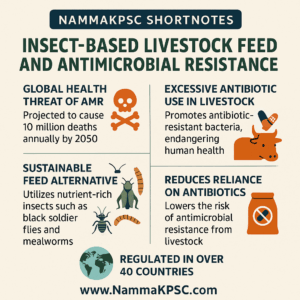
- Animal husbandry uses over 50% of global antibiotics, projected to rise by 53% from 2013 to 2030.
- Overuse of antibiotics in livestock (to treat disease and promote growth) creates resistant bacteria, which spread through waste, water, and soil.
- In low- and middle-income countries (LMICs), regulation is weak, with banned antibiotics like chloramphenicol, tylosin, oxytetracycline still in use.
- Human exposure to residues from livestock antibiotics increases risk of kidney disease, cancers, and aplastic anaemia.
CONCEPT: INSECT-BASED FEED AS A SUSTAINABLE ALTERNATIVE
What is Insect-Based Feed?
- Uses insects like black soldier flies, houseflies, crickets, mealworms, etc. as protein-rich feed for livestock and aquaculture.
- These insects are natural food sources for many terrestrial and aquatic animals.
Benefits Over Traditional Feed
- Highly nutritious – rich in digestible proteins, fats, micronutrients (zinc, calcium, iron, fibre).
- Better protein digestibility than fishmeal and soybean meal:
- Example: 1 kg fish meal ≈ 0.85 kg black soldier fly larvae (66% protein).
- Eco-friendly:
- Emits lower GHGs than conventional livestock feed.
- Requires less land, water, and energy to produce.
- Waste-to-feed potential:
- Insects can convert organic/agricultural waste into high-value proteins and fats.
- Economical:
- Lower production cost with better benefit-to-cost ratio.
- Crickets need 12x less feed than cattle for same protein output.
Role in Combating AMR
- Replaces need for antibiotic-laden feed in livestock.
- Reduces selective pressure on gut bacteria to develop resistance genes.
- Breaks the AMR transmission cycle from animal farms to humans.
CURRENT: INDIAN INITIATIVES & GLOBAL ACCEPTANCE
Indian Research & Implementation (ICAR)
- ICAR & affiliated centres are actively promoting insect-based feeds.
- March 2023: ICAR-CIBA signed MoU with Ultra Nutri India Pvt. Ltd. to use black soldier fly larvae in aquaculture.
- June 2024: ICAR-CIBA collaborated with Loopworm (Bengaluru) for shrimp and Asian seabass feed.
- January 2025: ICAR-CMFRI signed MoU with Bhairav Renderers (Coimbatore) for further feed development.
- Focus on boosting growth, immunity, and reducing AMR in aquatic animals.
Global Developments
- 40+ countries have approved regulations for insect-based animal feed.
- Supported by UN FAO, which projects a 70% increase in food demand by 2050.
- Considered a climate-smart, circular-economy-based feed solution.
SUMMARY POINTS FOR EXAM
- AMR is worsened by misuse of antibiotics in livestock feed.
- Insect-based feed offers a sustainable, eco-friendly, and health-safe alternative.
- Nutritionally superior and economically viable, especially for LMICs like India.
- Black soldier fly is a key species in India’s push toward sustainable aqua-feed.
- ICAR is actively leading research, partnerships, and field-level testing.
- Systemic adoption can cut GHG emissions, preserve antibiotic effectiveness, and ensure food security.
MAINS QUESTION
- Evaluate the potential of insect-based feed to combat AMR, highlighting its ability to reduce the need for antibiotic-laden feed and break the AMR transmission cycle.
- Discuss the current status of insect-based feed research and implementation in India, including the initiatives and partnerships led by ICAR.

You must be logged in to post a comment.