
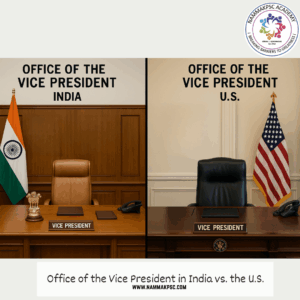
OFFICE OF THE VICE PRESIDENT IN INDIA VS. THE U.S.
OFFICE OF THE VICE PRESIDENT IN INDIA VS. THE U.S.
Introduction
-
The office of the Vice President (VP) in India was modelled after the U.S. system.
-
Intended to serve dual roles: as Rajya Sabha Chairperson and as a stand-in for the President.
-
However, its limited visibility and constitutional scope contrast sharply with its American counterpart.
Origin and Constitutional Intent
-
Borrowed from the U.S. Constitution, where the VP is an integral part of the executive.
-
In India, Article 63 provides for a Vice President mainly to:
-
Step in temporarily for the President.
-
Preside over the Rajya Sabha.
-
Why this matters:
-
In the U.S., the VP is deeply embedded in the executive structure; in India, he remains on the fringes.
Presidential Succession: India vs U.S.
-
U.S. VP: Automatically becomes President for the remainder of the term.
-
Historical instances: Nine VPs have succeeded as President upon vacancy.
-
-
Indian VP: Acts as President only temporarily.
-
A new President must be elected within 6 months (Article 65).
-
Does not complete the remaining term.
-
Implication: Succession in India is procedural and interim, not automatic or enduring.
Legislative Function: Presiding Over the Upper House
-
U.S.: VP presides over a powerful Senate with significant checks on the executive.
-
India: VP presides over the Rajya Sabha, which is less powerful than the Lok Sabha.
-
Members of Rajya Sabha are indirectly elected.
-
Speaker of Lok Sabha holds more influence than the Rajya Sabha Chairperson.
-
Contrast: The VP’s legislative stature in India is diluted due to the limited powers of the Rajya Sabha.
Visibility and Political Significance
-
In the U.S., the VP is part of the President’s inner circle—National Security Council, foreign missions, and executive affairs.
-
In India, the VP is politically distant from the executive.
-
Elections for President and VP are separate.
-
The VP has no regular executive duties.
-
Result: The office lacks political or administrative clout in day-to-day governance.
Structural and Systemic Mismatch
-
India follows a parliamentary system, unlike the presidential U.S. system.
-
The PM and Cabinet hold real power; the President and VP have limited ceremonial roles.
-
The VP’s office has remained largely symbolic with rare instances of assertive influence.
Paradox: A constitutional import intended to be impactful became a marginal office.
Way Forward
-
Reconsider the functional relevance of the Vice-President in a parliamentary democracy.
-
Enhance the legislative role or limit the ceremonial expectations.
-
Reforms could clarify succession, powers, and visibility of the office.
Conclusion
The Indian Vice President’s office, though inspired by the robust American model, remains structurally constrained. In a parliamentary setup with a weak Upper House, the position remains ceremonial, lacking the political weight it enjoys in a presidential democracy.
For classes, materials, test series and mentorship – contact us at +91 6366-294954

You must be logged in to post a comment.