
Published on: December 11, 2025
WESTERN TRAGOPAN
WESTERN TRAGOPAN
NEWS – Breeding Project Gives Endangered Western Tragopan Breathing Space
BACKGROUND: A CRITICALLY THREATENED HIMALAYAN PHEASANT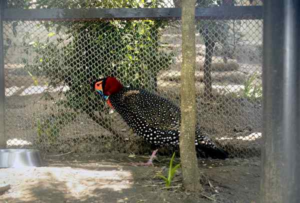
- The western tragopan (Tragopan melanocephalus) is one of India’s rarest pheasants and the state bird of Himachal Pradesh.
- Once found across J&K, Himachal Pradesh, Uttarakhand, it now survives in fragmented pockets.
- IUCN estimates only 3,000–9,500 mature individuals, forming a single subpopulation, making the species extremely vulnerable.
- Climate-change-driven habitat shifts and persistent human disturbance worsen the decline.
Habitat Challenges & Field Observations
- Surveys from Kazinag and Limber (J&K) show that suitable habitats exist, but fragmentation and human presence threaten survival.
- Birdwatchers report the species still persists deep within the Great Himalayan National Park, though sightings remain rare.
SARAHAN PHEASANTRY: WORLD’S FIRST CAPTIVE BREEDING SUCCESS
Key Achievements
- First captive births: 1993; breakthrough success at Sarahan Pheasantry in 2005 with four chicks.
- Between 2007–2015, 43 captive-born birds recorded; current population stands at ~46 birds.
- Experts improved survival by:
- Replicating natural vegetation and nesting material.
- Seasonal diet adjustments.
- Minimising stress and disease exposure.
- Genetic studies: captive stock retains 87% genetic diversity from just eight wild founders.
Concerns: Climate Change & Habitat Neglect
- Captive breeding is only an “insurance policy”, not a substitute for habitat conservation.
- Climate variability disrupts synchronisation between breeding timing and insect availability, risking chick starvation.
- Experts warn that without in-situ habitat protection, decades of ex-situ work may offer limited conservation value.
REWILDING: PROGRESS STALLED
- Experimental releases in 2020–21 showed promise; one bird survived nearly a year in the wild.
- Reintroductions halted since 2023 due to budget constraints and need for stronger scientific protocols.
- Release planning requires habitat assessment, predator monitoring, and behavioural adaptation studies.
COMMUNITY ROLE & PATH AHEAD
- Local communities in Himachal Pradesh have reduced disturbances by promoting eco- and bird tourism.
- Community stewardship incentivises habitat protection and reduces pressure on forests.
- Long-term survival depends on integrated strategies:
- Strengthened habitat protection
- Climate-adaptive conservation models
- Continued captive breeding and phased rewilding
- Community-led conservation
Bottom Line: The breeding programme offers hope, but without protecting the western Himalayas’ rapidly changing habitats, the western tragopan remains perched on the edge of survival.

You must be logged in to post a comment.