
DEMOGRAPHIC TRANSITION MODEL (DTM) & INDIA’S POPULATION DYNAMICS
DEMOGRAPHIC TRANSITION MODEL (DTM) & INDIA’S POPULATION DYNAMICS
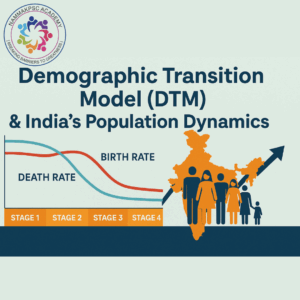
The Demographic Transition Model (DTM) describes how a country’s population changes with industrialization and development, characterized by shifts in birth and death rates across five stages.
Stages of DTM:
- Stage 1: High Stationary (Pre-industrial): High birth and death rates; very slow population growth.
- Example: Pre-18th century societies.
- Stage 2: Early Expanding (Early Industrialization): High birth rates, rapidly declining death rates; rapid population growth.
- Example: India in early 20th century, Sub-Saharan Africa today. Driven by improved healthcare, sanitation, and food.
- Stage 3: Late Expanding (Maturing Industrialization): Rapidly falling birth rates, slowly declining death rates; still increasing but slowing population growth.
- Example: India (post-1980s), Brazil. Influenced by family planning, urbanization, and women’s status.
- Stage 4: Low Stationary (Post-industrial): Low birth and death rates; stable or very slow population growth.
- Example: USA, Australia. Reflects industrial economy, high literacy, delayed marriages.
- Stage 5: Declining (Proposed): Very low or below replacement birth rates, low death rates (potentially rising due to aging); negative or declining population growth.
- Example: Japan, Germany, Italy. Driven by aging population, reluctance to have children.
Key Concepts :
- Malthusian Theory vs. DTM: DTM counters Malthus by showing that birth rates eventually decline with development.
- India’s Current Stage: India is primarily transitioning between Stage 3 and Stage 4, showing significant regional disparities.
- Other Population Transitions: Beyond birth/death rates, transitions include increased life expectancy, aging population, formal literacy, standard of living, status of women, health & hygiene, and secularization.
DTM & Recent Current Affairs (as of July 2025)
India’s Position & Regional Disparities:
- India is between Stage 3 (Late Expanding) and Stage 4 (Low Stationary), with fertility rates declining nationally but significant regional variations.
- High Fertility States (Stage 2 & 3 dynamics): States like Bihar (TFR ~2.98, NFHS-5) and Uttar Pradesh still exhibit higher TFRs due to socio-economic factors. Government initiatives like Mission Indradhanush and Ayushman Bharat address death rates and health.
- Low Fertility States (Stage 4 dynamics): Southern states like Kerala and Tamil Nadu have TFRs below replacement level (<2.0), facing aging populations and a rise in lifestyle diseases. This necessitates policy shifts for elderly care, as seen in the Draft National Population Policy (2024) addressing stabilization and delayed marriages.
- Emerging Stage 5 Concerns: India’s national TFR dropped to 2.0 (NFHS-5, 2023), below the replacement level (2.1), signaling a future demographic slowdown. Learning from nations like Japan and China (whose populations began declining in 2023), India must leverage its demographic dividend before it narrows.
Key Insights from Recent Reports:
- NFHS-5 (Ministry of Health and Family Welfare):
- Underage Marriages: Decreased nationally (women: 23.3%; men: 17.7%) but increased in states like Tripura and West Bengal.
- Teenage Pregnancy: Reduced to 6.8%.
- Contraceptive Use: Increased to 67%, linked to socioeconomic progress.
- Domestic Violence: Declined to 29.3%.
- Total Fertility Rate (TFR): Declined to 2.0 nationally, with only five states (Bihar, Meghalaya, UP, Jharkhand, Manipur) above the replacement level of 2.1.
- Institutional Births: Increased to 89%.
- Obesity: Increased among both men and women.
- Women Empowerment: Increased participation in household decisions and bank account ownership.
- Clean Cooking Fuel & Sanitation: Improved usage.
- State of World Population 2025: UNFPA – ‘The Real Fertility Crisis’:
- India’s Population (2025): 146.39 crore (highest globally), projected to peak around 170 crore in the 2060s.
- India’s TFR (2025): 1.9 (below replacement level).
- Demographic Dividend: 68% working-age population (15-64 years), peaking around 2041.
- Life Expectancy: Men: 71 years, Women: 74 years.
- Unintended Pregnancies: 36% of Indians experience them; 30% cannot fulfill desired family size.
- Global Trends: World population ~8.2 billion; 60% of countries now have below-replacement fertility; fastest growth in Sub-Saharan Africa.
- Global TFR: Declined from 5 (1950) to 2.25 (2024), projected to reach 2.1 by 2050.
- Aging Populations: Japan (30% over 65), Europe (20%), India (7% but rising).
Reasons for Fertility Decline in India:
- Improved Female Education and Empowerment: Delays marriage and childbearing.
- Rising Cost of Child Rearing: Economic concerns discourage larger families.
- Delayed Marriages and Career Aspirations: Shorten reproductive span.
- Decline in Infant Mortality & Improved Healthcare: Reduces the perceived need for many children.
- Changing Social Norms: Preference for smaller families, unequal domestic labor division.
- Fertility Awareness & Government Campaigns: “Hum Do, Hamare Do,” Mission Parivar Vikas, ASHA programs.
- Infertility & Health Challenges: Limited access to affordable infertility care and health issues.
Impacts of Declining Fertility in India:
- Positive: Demographic dividend opportunity, increased women’s empowerment, improved child investment, environmental sustainability, better health outcomes for women.
- Negative: Long-term shrinking workforce, aging population pressure, regional demographic imbalances, unfulfilled fertility aspirations, increased social isolation, disrupted family structures, and difficulty reversing the trend (as seen in Japan).
Challenges in Managing Fertility in India:
- Reproductive Agency Crisis: Limited access to informed reproductive choices.
- High Regional and Socioeconomic Disparities: Stark differences across states, castes, and income groups.
- Unmet Reproductive Goals: Gap between desired and actual fertility.
- Limited Access to Infertility and Specialized SRH Care: Lack of affordable services.
- Persisting Urban-Rural Divide: Gaps in family planning access and awareness.
- Cultural and Gender Norm Barriers: Patriarchal norms and son preference.
- Youth Reproductive Health Neglect: High adolescent fertility rates in poorer states.
Government Initiatives on Fertility in India:
- National Population Policy (NPP), 2000: Aims for replacement-level fertility via voluntary choice and improved maternal/child health.
- Mission Parivar Vikas (2016): Targets high-fertility districts with free contraceptives and communication.
- Family Planning 2020 (FP2020) & FP2030 Commitments: Universal access to family planning by 2030, new contraceptives.
- National Health Mission (NHM): RMNCH+A strategy addressing adolescent fertility, maternal care.
- Scheme for ASHA Workers: Incentivizes promotion of family planning and institutional delivery.
- Janani Suraksha Yojana (JSY) & Janani Shishu Suraksha Karyakram (JSSK): Promote institutional deliveries and post-delivery family planning.
- Laws on Marriage Age & Child Protection: Prohibition of Child Marriage Act, proposals to raise legal marriage age.
BHARAT Study: Healthy Aging in India
The BHARAT Study (Biomarkers of Healthy Aging, Resilience, Adversity, and Transitions), launched by IISc Bengaluru under the Longevity India Program, aims to identify India-specific physiological, molecular, and environmental indicators for healthy aging. This addresses the lack of India-specific aging data, which currently relies on Western standards that may misclassify Indian patients. The study will define “normal” biomarkers for healthy aging in India, utilizing AI for data analysis and intervention simulation. Its urgency stems from the projected sharp rise in age-related diseases in India, aiming for early detection and better health interventions.
NOTE
Apart from birth and death rates, there are several other transitions that a population experiences over time:
-
Life Expectancy: Increases from low to high.
-
Ageing Population: Increases as more people live longer.
-
Formal Literacy: Rises from low to high levels.
-
Standard of Living: Improves gradually from low to high.
-
Status of Women: Advances from low to high in terms of rights, education, and participation.
-
Health and Hygiene: Generally improves over time, moving from poor to good.
-
Secularization: Increases as the influence of religion on personal affairs tends to decrease.

You must be logged in to post a comment.