
INDIA–UK FREE TRADE AGREEMENT (CETA)
INDIA–UK FREE TRADE AGREEMENT (CETA)
India and the United Kingdom concluded the Comprehensive Economic and Trade Agreement (CETA) after 14 rounds of negotiations spanning over three years. This FTA is India’s first major trade pact with a G-7 nation since the post-Brexit repositioning of UK trade policy and aligns with India’s evolving approach toward strategic and diversified economic engagement globally.
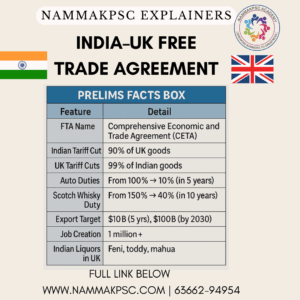
Key Aspirations:
- Enhance bilateral trade to $100 billion by 2030
- Facilitate tariff-free access to goods and services
- Unlock 1 million+ jobs across sectors
- Strengthen ties in technology, sustainability, and innovation
CONTEXT & STRATEGIC SIGNIFICANCE
- India’s Global FTA Strategy
- CETA is India’s 16th Free Trade Agreement
- Complements earlier FTAs with UAE (CEPA) and Australia (AI-ECTA)
- Strategically pivots away from overdependence on China and boosts GVC integration
- Part of the Make in India and Atmanirbhar Bharat initiatives
- UK’s Post-Brexit Agenda
- Aims to establish itself as a global trade hub post-EU exit
- Seeks to reinforce economic diplomacy with Commonwealth and Indo-Pacific
- India is among the top targets for UK trade diversification due to its market scale and growth potential
HEADLINE OUTCOMES
| Metric | Outcome |
| Zero tariff coverage | 99% of Indian goods, 90% of UK goods |
| Automobile duties | From 100%+ → 10% in 5 years |
| Scotch Whisky tariffs | From 150% → 40% in 10 years |
| Trade Target | $20B → $100B by 2030 |
| Jobs Expected | Over 1 million |
AUTOMOBILE SECTOR: A MAJOR BREAKTHROUGH
- Unprecedented Concessions
- First time India has offered auto duty concessions in any FTA
- Tariff cut on UK luxury and electric vehicles:
- From over 100% → 50% immediately
- To be reduced to 10% over 5 years
- Electric Vehicles (EVs) to see zero duty in 7 years
- Rules of Origin
- Quota system: Only 10,000 units/year qualify
- Origin criteria: Minimum 40–45% Regional Value Content (RVC)
- Consumer Impact
- UK car prices may fall by ~50%, benefiting India’s affluent consumer base
- Encourages EV adoption and aligns with India’s Net Zero vision
ALCOHOL TARIFFS: SCOTCH WHISKY GAINS
- Immediate Tariff Reduction
- From 150% → 75% immediately
- Long-Term Reduction
- Reduced to 40% by Year 10
- Quota of 2 million litres/year at 30% tariff
- State-Level Impact
- Retail price to vary due to state excise regimes
- Overall import volumes and consumption likely to rise
UK CONSUMER GOODS: TARIFF PHASEOUT
- Immediate Benefits (64% of goods)
- Includes lamb, salmon, machinery, aircraft parts, electronics
- Long-Term Phaseout (Next 26%)
- Includes chocolates, cosmetics, soft drinks over 10 years
- Indian tariffs on imported cosmetics to drop significantly, impacting domestic mid-premium brands
SECTOR-WISE GAINS FOR INDIA
- AGRICULTURE
- UK to remove tariffs on mangoes, bananas, tea, rice, spices
- Expected annual export boost: $1 Billion
- MARINE PRODUCTS
- Shrimp and prawn duties abolished
- Gains expected: $250M in 2–3 years
- TEXTILES & APPAREL
- Duty-free access: Boost of $1.5B exports in 2–3 years
- Crucial for MSMEs and employment
- ENGINEERING GOODS
- Targeted export increase to $4.28B by 2030
- PHARMACEUTICALS
- Regulatory harmonization and fast-track approvals
- Mutual recognition of Good Manufacturing Practices (GMP)
- CHEMICALS & PLASTICS
- Estimated gains: $570–750M, including $186.97M in plastics
- GEMS & JEWELLERY
- Duty-free access for polished diamonds
- UK projected to become $1B market for Indian jewellery
- LEATHER & FOOTWEAR
- Tariff elimination in 2–3 years
- UK’s quality and sustainability standards must be met
- EDIBLE OILS
- Lower tariffs on groundnut & sunflower oils
- Boost to oilseed farmers and processors
TRADITIONAL INDIAN LIQUORS: CULTURAL DIPLOMACY
- Feni, toddy, mahua cleared for retail sale in the UK
- Boosts soft power and rural artisanship
- Opportunity for branding India’s ethnic products globally
INNOVATION & SERVICES: A FIRST-OF-ITS-KIND CHAPTER
- Services Sector Liberalization
- Covers 115+ subsectors across 11 categories
- Negative list approach: All services open unless excluded
- Legal, IT, engineering professionals benefit from enhanced mobility
- Digital Trade & Innovation
- Cross-border data flows permitted with public interest safeguards
- Recognition of e-signatures, e-authentication
- AI, fintech, cybersecurity cooperation frameworks introduced
- IPR & Startups
- Fast-tracking of patents and trademarks
- Joint GI recognitions (e.g., Darjeeling Tea, Scotch Whisky)
- Annual IPR dialogues to update policy alignment
RULES OF ORIGIN & CUSTOMS EFFICIENCY
- Origin Criteria
- Goods must meet 40–45% value addition within the two countries
- Self-certification permitted with documentation retained for 5 years
- Border Efficiency
- Perishable goods: Clearance within 6 hours
- All consignments: Processed within 24–48 hours
- Electronic documentation, Single Window Clearance systems
- AEO (Authorized Economic Operator) benefits for compliant traders
AGRI-FOOD SAFETY & SPS HARMONIZATION
Key Agreements:
- UK will recognize Indian standards for:
- Basmati rice, grapes, mangoes, buffalo meat
- Pre-listing of Indian food processing units
- SPS Committee will resolve market access issues biannually
TECHNICAL BARRIERS TO TRADE (TBT)
- Notification of new regulations 60 days in advance
- Emphasis on international standards (ISO, Codex, etc.)
- Mutual recognition of testing and certification in sectors like electronics and toys
TRADE REMEDIES & SAFEGUARDS
- Both parties retain right to impose:
- Anti-dumping
- Countervailing duties
- Bilateral safeguards for import surges (max 8 years)
- Must follow transparent WTO-consistent investigations
TRADE & SUSTAINABLE DEVELOPMENT
- Binding clauses on:
- ILO labour standards
- Child and forced labour prohibition
- Paris Agreement adherence
- Joint Committee to oversee environmental outcomes
- Civil society and stakeholder engagement allowed
MSMEs & INCLUSIVE TRADE
Provisions:
- MSME contact points and dedicated FTA portals
- Capacity-building for regulatory and standards compliance
- Emphasis on digital inclusion and sustainable business models
INVESTMENT PROTECTION & CAPITAL FLOWS
- Non-discriminatory treatment & fair compensation in case of expropriation
- No investor–state arbitration, but structured intergovernmental consultation
- Free transfer of capital, royalties, dividends
PROFESSIONAL MOBILITY & VISAS
- Short-term visits (90 days) allowed without labour market test
- Intra-corporate transfers: 3 years + 2-year extension
- Visa processing: UK (3 weeks), India (4 weeks)
- Independent professionals covered under sectoral quotas
GOVERNMENT PROCUREMENT
- India gets access to UK’s $135B procurement market
- Thresholds:
- Goods & services: > $270,880
- Construction: > $2.03 million
- Indian firms can bid in transparent, fair environments
DISPUTE RESOLUTION FRAMEWORK
- Dispute redressal via:
- Consultations
- Panel-based adjudication
- Binding decisions
- Timelines:
- 45 days for hearing
- 120–150 days for final ruling
- Compliance reviews and public transparency
EVOLUTION, FLEXIBILITY & SOVEREIGNTY
- Public health, taxation, national security excluded
- 5-year review cycles
- Provisions for future amendments and new accessions
- Encourages dynamic updating with tech and legal developments
INSIGHTS & THEMES
- Trade Diplomacy & Economic Strategy
- India balances openness with sectoral protection
- Strengthens negotiation credibility in future FTA talks (EU, GCC)
- Make in India & Atmanirbhar Bharat
- Enhances manufacturing capacity, particularly in auto, textiles, and chemicals
- Inclusive Growth & MSME Support
- Tariff liberalization focused on labour-intensive sectors
- Digital and legal support for small exporters
- Soft Power & IR Strategy
- Indian liquors and GIs enhance cultural exports
- UK ties deepen beyond economy—R&D, climate, diaspora diplomacy
- GVC Resilience
- Strengthens India’s participation in alternative global supply chains
CONCLUSION
The India–UK CETA symbolizes a mature trade relationship between two democracies rooted in mutual respect, shared legal frameworks, and strategic ambition. It advances India’s transition from protectionist trade frameworks to outward-oriented economic diplomacy, while providing a blueprint for future FTAs with developed nations

You must be logged in to post a comment.