
NATIONAL EDUCATION POLICY V/S KARNATAKA STATE EDUCATION POLICY
NATIONAL EDUCATION POLICY V/S KARNATAKA STATE EDUCATION POLICY
Introduction
-
Karnataka government released a 2,197-page State Education Policy (SEP), an alternative to NEP 2020.
-
Key focus: Free education for girl students up to graduation and extending reservations to private institutions.
-
SEP emphasizes affordability, quality, and social justice, aligning with constitutional socialist principles.
NEP vs SEP: Goals and Challenges
1. National Education Policy (NEP) 2020 Objectives:
-
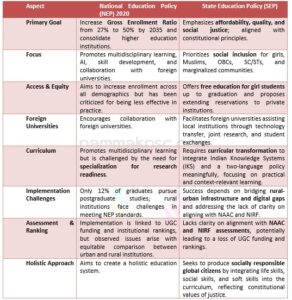
Increase Gross Enrollment Ratio from 27% to 50% by 2035.
-
Consolidate higher education institutions from 58,000 to 12,000.
-
Promote multidisciplinary learning, AI, skill development, and foreign university collaboration.
2. Observed Challenges:
-
Only 12% of graduates pursue post-graduate studies; 1% proceed to research.
-
NEP encourages multidisciplinary learning, but specialisation is crucial for research readiness.
-
The mushrooming of private HEIs often focuses on profit over access.
3. SEP Approach:
-
Facilitates foreign universities helping local institutions through technology transfer, joint research, and exchanges.
-
Prioritizes social inclusion for girls, Muslims, OBCs, SC/STs, and marginalized communities.
-
Affordability and quality are central, but curricular transformation is needed for genuine inclusion.
Structural and Institutional Concerns
-
SEP does not clarify NAAC and NIRF assessment alignment, crucial for institutional credibility.
-
Non-implementation of NEP components can lead to loss of UGC funding and rankings.
-
Assessment systems often compare urban and rural institutions on the same scale, ignoring contextual differences.
-
Intellectual upward mobility of first-generation learners and marginalized students is overlooked.
Inclusivity and Curricular Transformation
-
Higher education should focus on producing socially responsible global citizens aware of constitutional duties and human rights.
-
Curricular reform must integrate:
-
Indian Knowledge System (IKS) meaningfully.
-
Two-language policy with adequate teacher training.
-
Practical learning synchronized with digital tools and local contexts.
-
-
Paulo Freire’s principle: Education as “the practice of freedom” to enable learners to perceive social and economic contradictions.
Rural-Urban Divide and Digital Challenges
-
43% universities and 61.4% colleges are located in rural areas.
-
SEP’s success depends on bridging infrastructure gaps and addressing the digital divide.
-
Digital learning must be accompanied by teacher capacity building, context-relevant content, and linguistic accessibility.
-
Practical, hands-on learning cannot be replaced by online theory-only methods.
Holistic Education and Social Justice
-
SEP promotes life skills, social skills, and soft skills, ensuring students are competent and compassionate.
-
Inclusion must be beyond policy rhetoric, requiring institutional ethos overhaul, infrastructure improvement, and pedagogical reform.
-
Higher education should reflect the Constitution’s Preamble, ensuring social, economic, and political justice.
Conclusion
-
SEP is a positive step for affordability and social justice, but real inclusivity requires:
-
Curricular transformation.
-
Support for marginalized communities in access, retention, and upward mobility.
-
Integration of IKS and two-language policy meaningfully.
-
Addressing rural infrastructure and digital readiness.
-
-
The challenge is not only opening the gates of higher education but also reforming what lies within
For classes, materials, test series and mentorship – contact us at +91 6366-294954

You must be logged in to post a comment.