
National Flag Day
National Flag Day
- Date of Significance: July 22, 1947 – The Indian Constituent Assembly adopted the National Flag.
- The event marks India’s final assertion of symbolic sovereignty prior to Independence on August 15, 1947.
- Contextual Importance: Reflects the culmination of India’s freedom struggle, national identity formation, and constitutional evolution.
Official Adoption by the Constituent Assembly – July 22, 1947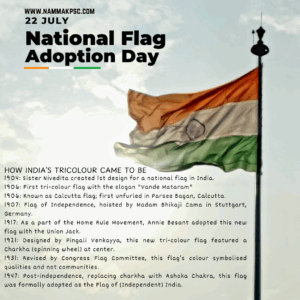
- Chaired by Dr. Rajendra Prasad, the ad-hoc Flag Committee was tasked with creating a flag representing all communities.
- Nehru proposed Venkayya’s modified flag with the Ashoka Chakra.
- Adopted just 24 days before Independence – a conscious act of symbolism and unity.
Symbolism of the Tricolour – Reflecting India’s Core Values
- Saffron (Top): Courage, sacrifice, renunciation – Honors the martyrs and revolutionaries.
- White (Middle): Peace, purity, and truth – Embodies the Gandhian ethos.
- Green (Bottom): Prosperity, agriculture, and fertility – Symbolizes India’s agrarian base and harmony with nature.
- Ashoka Chakra (24-spoked wheel): Progress and dynamism; taken from Sarnath Lion Capital, symbolizing dharma and governance.
Ethics Connection: The flag embodies virtue ethics—truth, sacrifice, duty—and forms a moral compass for nation-building.
The Ashoka Chakra: Eternal Wheel of Law
- Located at the center of the white band.
- 24 spokes = 24 hours; representing constant motion, vigilance, and change.
- Inspired by the Dharma Chakra of Mauryan Emperor Ashoka, 3rd century BCE.
- Symbol of righteous governance and moral duty.
Legal Framework: The Flag Code of India (2002)
- Consolidates all conventions and rules for flag use.
- Effective from: January 26, 2002.
- Allows private citizens to hoist the flag on all days with dignity.
- Strict restrictions on damage, misuse, and disrespect.
Key Regulations:
- Flag must always be placed higher and alone.
- No flag should be placed above it or garlanded.
- No damage, soiling, or misuse for commercial purposes.
Disrespect and Punishment: Prevention of Insults to National Honour Act, 1971
- Punishable acts: Burning, defiling, trampling, or disrespecting the flag in public view.
- Punishment: Imprisonment up to 3 years, or fine, or both.
- Includes both spoken, written, and symbolic acts of disrespect.
Right to Hoist the Flag: A Fundamental Right (2002 Judgment)
- In the Union of India v. Naveen Jindal case, the Supreme Court ruled that the right to hoist the national flag is part of Article 19(1)(a) – freedom of expression.
- Reinforces that national symbols are means of democratic participation, not state monopoly.
Who Can Display the Flag and When?
- All citizens, institutions, and organizations can fly the flag on any day, provided dignity and honour are maintained.
- Prohibited: Use as festoons, drapery, costumes, or below another flag.
Flag Size and Materials
- Ratio: 3:2 (Length:Height). Flag must always be rectangular.
- Material (post-2021 amendment): Allowed materials include khadi, cotton, silk, wool, polyester (handspun or machine-made).
- Earlier: Only khadi was permitted, as per Gandhian legacy.
Note: While khadi remains the symbol of the freedom movement, the inclusion of synthetic materials reflects pragmatism and inclusivity.
Vehicle Use and Official Restrictions
- Only designated dignitaries can fly the national flag on vehicles:
- President, Vice President, Prime Minister, Governors, Chief Justices
- Prohibited uses: Covering sides or tops of cars, or as seat/back covers.
- Must not touch the ground or water.
Pingali Venkayya – The Designer of the Flag
- Born: August 2, 1876 | Died: July 4, 1963
- Scholar, linguist, freedom fighter, army veteran.
- Proposed over 30 designs in his 1916 booklet on national flags.
- Met Gandhi in South Africa and proposed flag ideas during INC sessions.
- His final design formed the basis of India’s tricolour.

You must be logged in to post a comment.