
NEWS: The use of fibre-optic drones by Hezbollah in southern Lebanonà A major shift in modern asymmetric warfare due to their resistance to electronic countermeasures.
ABOUT
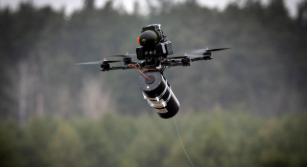
- Specialized First-Person View (FPV) drones/UAVs that use a physical fibre-optic cable instead of radio-frequency (RF) signals for communication.
- They transmit commands and video feeds through light pulses traveling inside a fibre-optic tether.
- Designed to overcome traditional electronic warfare systems such as jamming, spoofing, and RF interception.
HOW IT WORKS
- Physical Tetherà Drone remains connected to the operator through an ultra-thin fibre-optic cable.
- Spool Mechanismà The cable is wound on a spool mounted on the drone and unwinds during flight.
- Light-Based Communicationà Commands and real-time video are transmitted through optical signals.
- No Wireless Communicationà Eliminates dependence on RF signals and GPS-based navigation.
KEY FEATURES
- Immune to RF JammingàCannot be disrupted by conventional electronic warfare systems.
- Zero RF Signatureà Does not emit radio signals, making detection difficult.
- Real-Time High-Quality Videoà Provides high-bandwidth, low-latency video transmission.
- Extended RangeàAdvanced variants can operate up to 20–30 km.
- Stealth Capabilityà Difficult to track, intercept, or locate the operator.
LIMITATIONS
- Vulnerable to heavy rain, strong winds, and adverse weather conditions.
- Operational failure occurs if the fibre-optic cable is cut or entangled with obstacles such as trees or buildings.
- Physical tether can limit maneuverability compared to fully wireless drones.
SIGNIFICANCE
- Represents a new generation of electronic warfare-resistant drones.
- Enhances capabilities in reconnaissance, surveillance, and precision strikes.
- Challenges conventional air-defense and counter-drone systems.
- Increasingly important in modern conflicts and asymmetric warfare scenarios.