
Published on: July 15, 2025
LOCUST SWARMS
LOCUST SWARMS
NEWS – Researchers at the Chinese Academy of Sciences (published in Nature, June 25) have identified a key pheromone—4-vinylanisole (4VA)—that triggers swarming behaviour in locusts.
HIGHLIGHTS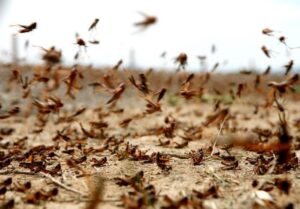
- Locust swarms devastate crops, posing a major threat to food security. A 1 sq. km swarm (≈40 million locusts) can consume food equivalent to 35,000 people daily.
- Mechanism: After feeding, locusts emit 4VA, which attracts others and triggers serotonin release, leading to swarming. The compound is produced via enzymes 4VPMT1 and 4VPMT2 after digestion of phenylalanine.
- Breakthrough: Scientists blocked 4VA production by deactivating the 4VPMT1 gene and using a molecule called 4-nitrophenol (4NP) to inhibit enzyme activity—disrupting swarm formation.
- Limitation: 4NP, though effective, is environmentally toxic and not viable for open-field use.
- Future Direction: The study suggests RNAi-based insecticides targeting 4VPMT enzymes as safer alternatives and proposes a five-step strategy including pheromone traps, biopesticides, and genetic modification.
- Significance: Offers the first eco-friendly, molecular-level locust control method, reducing reliance on harmful chemical pesticides.
- Wider Impact: Could transform locust management globally and aligns with sustainable agriculture goals. Further research on safer inhibitors is needed for field application.

You must be logged in to post a comment.